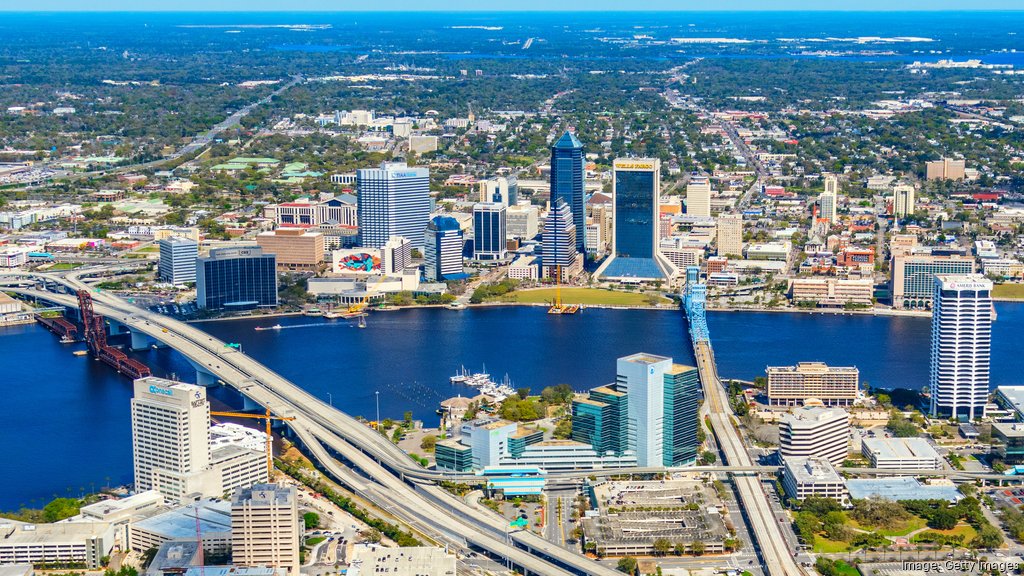
Downtown Jacksonville has long been a place where ambition often outpaced reality.
Renderings came and went. Big ideas surfaced, stalled or shifted. Public officials and civic leaders spent decades talking about the urban core’s comeback, even as many Jacksonville residents remained skeptical that the city center would ever reach the critical mass needed to feel like a true neighborhood.
Downtown Vision Inc.’s latest State of Downtown Report argues that moment is no longer theoretical.
The nonprofit Business Improvement District’s 2025 report shows a downtown with $7 billion in its development pipeline, 9,228 residents, 19.7 million annual visits and several of the region’s largest public and private projects moving from plans into active construction.
For DVI CEO Jake Gordon, the numbers point to a downtown that is entering a different phase.
“Investor confidence has never been higher,” Gordon told the Business Journal Wednesday.
The report covers Jan. 1 through Dec. 31, 2025, and marks DVI’s shift from an 18-month reporting cycle to a calendar-year format. The change is meant to better track downtown’s momentum across development, housing, office, tourism, parks, infrastructure and other measures of urban vitality.
The report lands at a moment when several transformative projects are advancing at once: Gateway Jax’s Pearl Square, Related Group’s RiversEdge, the Four Seasons Hotel and Private Residences, the Jacksonville Jaguars’ stadium renovation, the University of Florida graduate campus in LaVilla, Baptist Health’s McGehee Family Tower and new or improved riverfront parks on both sides of the St. Johns River.
“Downtown Jacksonville is no longer a future conversation. It is happening right now, and the momentum is undeniable,” said Colin Tarbert, CEO of the Downtown Investment Authority, in a statement accompanying the report.
A $7 billion pipeline
The report places downtown’s 2025 development pipeline at $7 billion, including $809 million completed in 2025, $3 billion under construction, $36 million approved and $2.8 billion in review or proposed.
That follows $2.6 billion in completed investment from 2000 to 2015 and $3.4 billion from 2016 to 2024, according to the report.
Gordon said those numbers matter because they provide a more concrete way to measure a downtown that has often been judged by perception.
Jacksonville has talked about downtown’s comeback through multiple mayoral administrations, he said. That long history can make residents focus on the stops and starts. But investors looking at the city today see a different picture: large parcels, rising demand, improving amenities and a downtown that still has room to grow.
The report describes 2025 as a “landmark year” in which “decades of visioning and planning yielded significant, tangible progress toward the multi-year transformation of North Florida’s urban center.”
Among the largest projects under construction or advancing are the $1.4 billion “Stadium of the Future” renovation, the $693 million RiversEdge development, the $500 million first phase of Pearl Square, the $387.6 million One Tower Court and Four Seasons project, the $250 million One Riverside project, the $202.7 million Southbank Residences tower and the $190 million Baptist Health expansion.
Gordon said the scale of those investments is important, but so is who is making them.
He pointed to local investors, such as JWB Real Estate Capital and Gateway Jax, as early movers that helped build confidence. But he also said the arrival of groups like Related, which has invested heavily elsewhere in Florida, signals that Jacksonville is now getting attention from companies that were not previously focused on the market.
Downtown nears 10,000 residents
Perhaps the most important number in the report is not the dollar value of the pipeline, but the number of people now living downtown.
Downtown Jacksonville’s residential population reached 9,228 in 2025, a 20.5% increase from the previous year and a 97% increase since 2016, according to the report. The urban core had 5,655 residential units and a 96% occupancy rate, with the report’s summary page listing 1,576 units under construction and its housing section pointing to more than 2,100 units under construction in the broader pipeline.
The report projects downtown’s population could reach 13,382 by 2028, with the number of units increasing to 8,200.
For years, 10,000 residents has been treated as a key milestone in downtown’s effort to support more restaurants, retailers, grocery stores and neighborhood services. Gordon said downtown is now close enough that the milestone feels real rather than aspirational.
He said the increase from 2016 is especially striking because that was his first full year working in downtown Jacksonville.
“The idea that we’ve added that many residents, more than double the residents, is really impressive,” Gordon said.
The report says 2025 brought 1,380 new residents occupying 958 newly constructed units, primarily from Artea on the Southbank, One Riverside in Brooklyn, Union Terminal Warehouse in the Sports and Entertainment District, Lofts at Cathedral in Cathedral Hill and Johnson Commons in LaVilla.
Gordon said the market is also becoming more varied. Downtown now includes affordable housing, market-rate apartments, high-end rentals, townhomes and luxury riverfront options.
That range matters, he said, because the urban core is becoming a more realistic choice for different types of residents.
“It’s literally a more attractive option as a place to live than it’s ever been,” Gordon said.
He pointed to the Toll Brothers townhomes at RiversEdge, where units have been selling for more than $1 million, as one example of how far the market has moved.
For Gordon, the takeaway is not only that downtown has added residents. It is that people are willing to pay premium prices for new housing in the urban core, especially when it is paired with riverfront parks, walkability and nearby amenities.
The 96% occupancy rate also gives developers a stronger case for future projects.
“If you build buildings and they’re not all the way full, that’s not a good sign,” Gordon said. “But 4% vacancy in residential units is really good.”
Big projects need small projects
The report is anchored by major developments, but Gordon said downtown’s future cannot be built on marquee projects alone.
Pearl Square, RiversEdge, the stadium renovation, the Four Seasons and UF’s graduate campus can change downtown’s trajectory. But smaller storefronts, restaurants, bars and adaptive reuse projects are what fill in the experience between those anchors.
“You need both,” Gordon said.
He said it would be unrealistic to expect public agencies to spend the same amount of time on a small restaurant or bar as they spend on a billion-dollar stadium deal. Still, the success of downtown from a visitor or resident perspective often depends on the density of smaller uses between large investments.
Projects such as The Raven, Mag’s Cafe and other independent concepts may not carry the same tax base or construction cost as a tower or campus, but Gordon said they help shape the day-to-day experience of downtown.
That balance is central to the next phase of downtown’s growth.
Gordon described downtown as a kind of barbell, with the Sports and Entertainment District and riverfront investment on one end and LaVilla, the JTA Regional Transportation Center and UF graduate campus on the other. The challenge now is filling in the space between those anchors so that downtown functions as a connected district instead of a collection of isolated nodes.
The DIA’s approach to the former courthouse and City Hall Annex site is one example, he said. Rather than wait for a single massive redevelopment of the entire site, the agency moved forward with a portion of the property near the Hyatt Regency Jacksonville Riverfront, where Corner Lot is planning a riverfront project.
That type of incremental strategy, Gordon said, can help raise values and make the next phase more viable.
“You can’t just roll one ball uphill,” he said. “You’ve got to roll all balls at the same time to make downtown great.”
Parks become an economic development tool
The report describes 2025 as a “monumental year” for downtown public spaces, with the opening of or improvements to Riverfront Plaza, the parks at RiversEdge and the playground at St. Johns River Park/Friendship Fountain.
The first phase of Riverfront Plaza opened in November 2025 at the former Jacksonville Landing site. The $32.5 million phase includes a six-acre urban park with a playground and tiered lawn. The report says it drew nearly 21,000 visitors in its first month.
The playground at St. Johns River Park/Friendship Fountain, completed in April 2025, welcomed more than 55,000 visitors within its first month, according to the report.
The parks at RiversEdge, a $35 million component of the Southbank mixed-use development, hosted more than 20,000 visitors within the first month of opening.
The report also says 74% of visitors to downtown’s three new riverfront parks in their first month came from within 3 to 30 miles of downtown Jacksonville, suggesting the spaces are drawing regional residents, not only nearby downtown users.
More than $230 million in additional public space investment is in the pipeline, including Riverfront Plaza Phase 2, McCoys Creek Park, the Riverfront Music Garden, Metropolitan Park, Shipyards West Park, James Weldon Johnson Park and Hogan’s Creek Restoration & Greenway.
Gordon said those investments matter because public spaces help connect the larger development nodes now taking shape.
He pointed to the Riverwalk, Emerald Trail, scooters, bike lanes and other mobility options as key pieces of downtown’s next phase. As downtown grows, he said, the question should not be how to make it easier for every visitor to park directly in front of every destination. It should be how to create more ways to move through the urban core without relying on a car for every trip.
“Our car-centric transportation should not be the focus,” Gordon said.
Mobility becomes the next challenge
As Brooklyn, Pearl Square, RiversEdge, the Sports and Entertainment District and LaVilla all grow, Jacksonville faces a new challenge: making those areas feel connected.
Gordon said that will require a mix of transportation options, including walking trails, scooters, bikes, riverfront connections, ride-share, transit and better use of existing parking.
He said downtown still has plenty of parking if people are willing to walk a few blocks, but he cautioned that cities trying to build stronger downtowns are not solving their growth challenges by simply adding more parking garages.
“There is not one city in America that’s building up its downtown that’s choosing parking garage,” Gordon said.
The point, Gordon said, is also tied to downtown’s economics. Parking garages and surface lots produce less taxable value than dense mixed-use buildings, offices, hotels and residential towers. A stronger downtown tax base helps fund services and infrastructure across the broader city.
He compared the issue to other cities that invested in their downtowns over decades, including Nashville, Tampa and Miami. Those cities now face problems of congestion and affordability, but they also show the fiscal power of dense urban districts.
Jacksonville, he said, has a different challenge because of its size. With nearly 900 square miles, the city must provide infrastructure over a vast area. A stronger downtown can help support that broader system.
“What you would want is a very dense urban core that funds a lot of your city,” Gordon said.
A turning point, not a finish line
The report’s overall message is optimistic, but Gordon cautioned that downtown revitalization does not have a final endpoint.
Even cities with far larger and more mature downtowns are still working on density, transit, parks, housing, affordability and retail.
“It’s literally a race that never is done,” Gordon said.
For Jacksonville, the difference is that the next phase is now more visible.
Cranes are in the air. Residents are filling new buildings. Riverfront parks are opening. Major institutions are expanding. Investors who once overlooked Jacksonville are paying attention.
The challenge now is whether those pieces can be connected into a cohesive downtown experience.
The report notes downtown occupies less than 1% of Jacksonville’s land area but provides 4.3% of the city’s property tax revenue, 32% of its hotel tax revenue and 8% of its sales tax revenue. It also serves as the region’s cultural center, employment hub and primary gathering place.
Gordon said that makes continued investment in downtown not only a civic priority, but a citywide business case.
“Downtown is an important part of that,” he said. “Incentivizing the urban core to get better is valuable.”
By James Cannon
Jacksonville Business Journal